

Mutagens
UV radiation does not have enough energy to break the phosphodiester bonds in nucleic acids as shorter-wavelength radiation like X-rays can.
However, it does catalyze the formation of covalent bonds between adjacent pyrimidine bases, creating pyrimidine dimers.
The image below shows the formation of a 4-carbon ring between two adjacent thymine residues, due to UV-catalyzed covalent bonding.

Click the buttons to investigate a normal B-DNA double helix and a DNA double helix with a thymine dimer (highlighted in yellow).
Hydrogen atoms have been removed for clarity.
Hold the shift key while moving the mouse up/down to zoom in on the image and investigate the molecular geometry effects of the thymine dimer more closely.
Explain why pyrimidine dimers, if left unrepaired, can cause problems with correct DNA replication.
This DNA double helix with the thymine dimer also contains 5-bromouracil (5BU), a base analog.
5-bromouracil is a brominated derivative of uracil. Bromine is colored maroon in this model.
Thymine is a methylated derivative of uracil, so its structure is very similar to that of 5BU. Examine the image below comparing thymine and 5-bromouracil.
The electronegativity of bromine is 2.8, while carbon is 2.5 and hydrogen is 2.1.
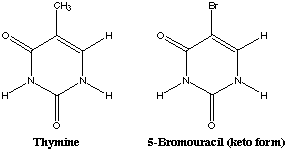
Click the button below to investigate the base pair formed by 5-bromouracil in this DNA double helix. Remember that hydrogens are not shown in this model.
5-bromouracil Base PairWhat is the most probable type of mutation caused by incorporation of a base analog?
Insertion
Deletion
Substitution
During DNA replication, which base is most likely to be paired with the keto form of 5-bromouracil? (Hint: it is the one shown paired with 5BU in the Jmol model.)
Adenine
Guanine
Cytosine
Thymine
5-bromouracil
How many hydrogen bonds are formed between the keto form of 5-bromouracil and the complementary base pairing partner you chose in the last question?
1
2
3
5-Bromouracil can exist as a few different tautomers. It is more commonly found as one of its minor tautomers than A, C, G, and T are, so after being incorporated into DNA, it frequently switches to a different tautomeric form.
Examine the structure of 5-bromouracil, and look for the potential to form an 'enol' tautomer analogous to the 'enol' tautomer of thymine.
During DNA replication, which base is most likely to be paired with the enol form of 5-bromouracil?
Adenine
Guanine
Cytosine
Thymine
5-bromouracil
Intercalating agents are chemical mutagens that insert themselves between stacked base pairs in double-stranded DNA.
One example of an intercalating agent is the antibiotic and anti-cancer drug actinomycin. The structure of actinomycin is shown below.

A molecule of actinomycin intercalating into DNA is shown by the Jmol button below. One of the DNA strands has been removed for clarity.
Notice how the intercalating molecule is wedged in between two bases in the DNA strand.
What is the most probable type of mutation caused by an intercalating agent?
Insertion
Deletion
Substitution