Basic Principles that Drive Protein Folding
An Expansion Activity to the Amino Acid Starter Kit

An Expansion Activity to the Amino Acid Starter Kit
© Copyright 1995- - MSOE Center for BioMolecular Modeling


Proteins are large, complex molecules that are made in the polar, watery environment of the cell. They are made by joining amino acids together in a particular sequence. Because each of the 20 amino acids is different in shape and chemical property, proteins fold up into amazingly complex 3-dimensional shapes following basic principles of chemistry.

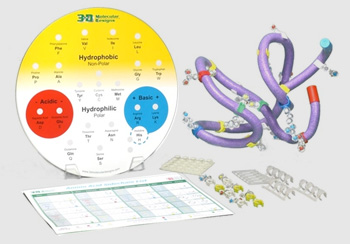
You have just used the Amino Acid Starter Kit to fold a 15 amino acid protein into a complex shape that simultaneously satisfied 3 principles of chemistry. In this Jmol exploration of the beta-globin protein you will ask how accurately this real protein reflects these principles of chemistry in its final, folded structure.
The beta-globin protein is composed of 146 amino acids. Its function is to bind and transport oxygen around your body. There are about 500 million copies of this protein in each one of your red blood cells.
In the interactive Jmol window to the right, a single beta-globin protein is shown in a "spacefilled format". In this format, each atom of this 146-amino acid protein is shown as a color-coded sphere;
This spacefilled format is not very useful in seeing how the linear sequence of 146 amino acids folds up into a compact shape. If we fade out all of the atoms except the alpha carbon of each amino acid, and then connect each alpha carbon with a cylinder, we have an alpha carbon backbone model of the protein.
In this backbone format we can see that the protein folds up into a series of 8 alpha helices (the protein’s secondary structure) – which in turn fold up into a compact, globular shape (the protein’s tertiary structure).
For the interactive Jmol display to function correctly, a Javascript enabled HTML5 compatible browser must be used, including: